Articles of Association

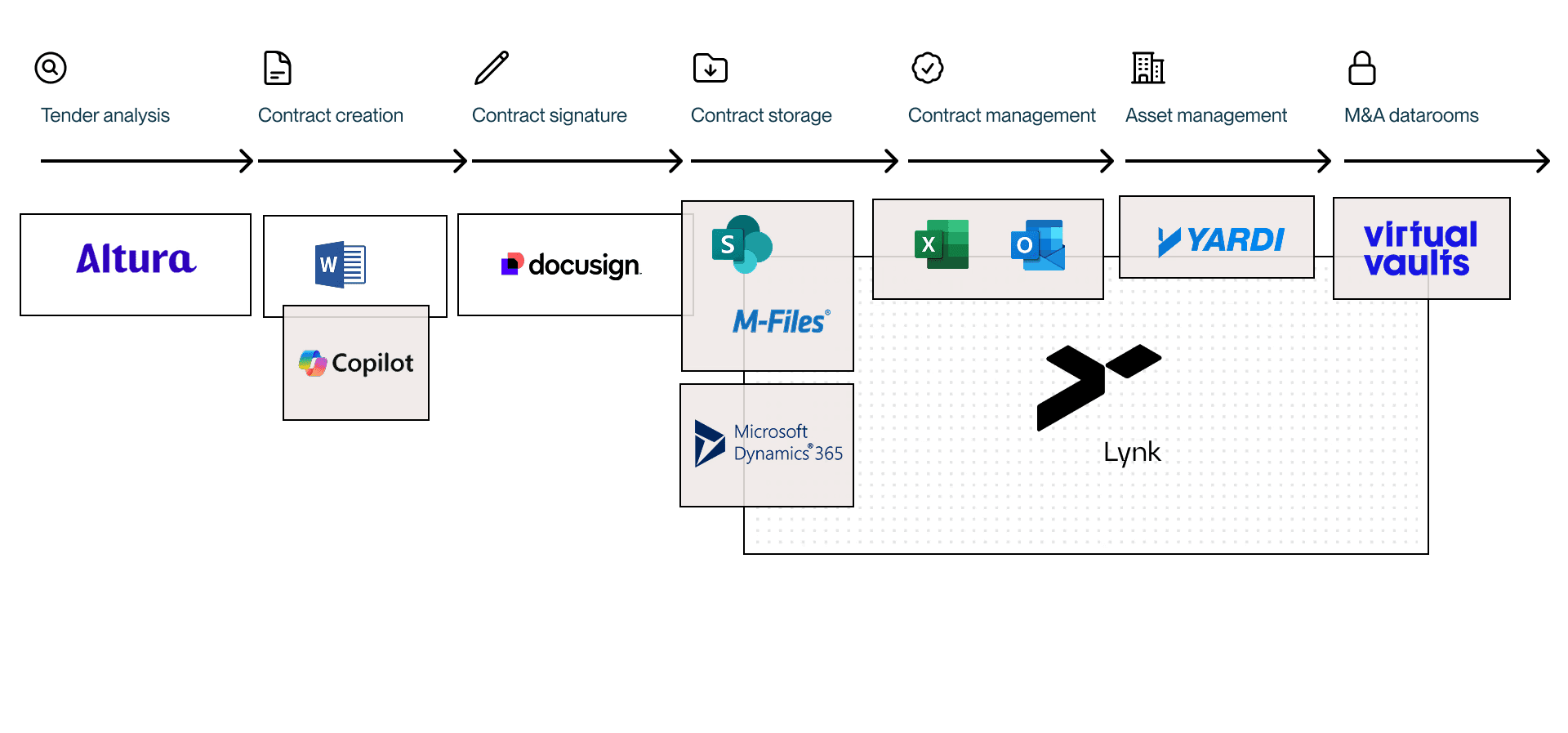
Mapping the contract lifecycle: bridging the gap between storage and strategy
Whether you are building physical infrastructure, managing large-scale assets, or executing complex long-term projects, a contract is never just a piece of paper. Contracts are the solid foundation of which organizations conduct businesses. Yet, when you look at the IT landscape of a typical business, the reality of how we manage these agreements is often highly fragmented.
Take a look at the contract lifecycle. We use specialized tools for every individual step. We analyze tenders with Altura. We draft documents using Word. We securely sign them via DocuSign. And finally, we lock the signed PDF safely away in a digital archive like SharePoint, M-Files, or Dynamics 365.
It feels like we're in control. But the reality is that the lifecycle breaks exactly when the real work begins.
The Excel and Outlook trap
Once a contract is signed and stored, the actual execution phase starts. But how do we manage these complex agreements on a daily basis? Often, we downgrade to tracking deadlines in a static Excel sheet that is outdated the moment you save it, or we lose critical context in chaotic Outlook email threads.
When your contract management relies on manual tracking, you're still doing the heavy lifting yourself. Your professionals have to manually "read" the data, connect the dots, and simply hope a colleague is aware of that one crucial liability clause. In an environment where margins are tight, accountability is high, and risks are substantial, relying on human memory and scattered spreadsheets places your organization in a vulnerable position.
Why your current stack is not enough
It is tempting to think that the tools you already have can solve this gap. But let's look at the specific functions of your IT stack:
Let's start with the digital archive, like M-Files or SharePoint. These systems are fantastic for organization-wide storage. However, as explained in our previous article, 'M-Files vs. Lynk', storing a document securely is fundamentally different from actively managing its risks. An archive waits for you to ask a question; it does not proactively warn you about an expiring bank guarantee.
Subsequently, there's the rise of AI agents in the creation phase. Microsoft Copilot is a great tool for drafting a quick text in Word. But as we discussed in 'Copilot vs. Lynk', a generic chat interface lacks the rigorous structure required for complex legal documents. It is an ad hoc assistant, not a single source of truth.
The intelligence layer your lifecycle is missing
To grow without losing oversight on your agreements, contract management needs to move out of the static silo and into the active operations of your organization. You need a system that doesn't just store a contract, but actually understands the obligations inside it and connects them to the people doing the work.
This is exactly where Lynk positions itself in the lifecycle.
Look at the landscape again: Lynk bridges the critical gap between passive storage and active management. We do not replace your M-Files or SharePoint; we connect to them. We extract the complex agreements from your digital archives and translate them into a structured, active workflow. We replace the manual Excel trackers and the fragmented Outlook discussions with one clear, reliable source of truth.
From searching to building
For a CFO, this means real-time insight into financial obligations. For a Legal Head, it means immediate visibility into liabilities and risks. For a Controller, it means accurate, structured data that seamlessly feeds into downstream systems like Yardi or Virtual Vaults.
Ultimately, your professionals should not be spending their valuable time searching for clauses or updating spreadsheets. Computers should do the checking and the analytical heavy lifting, so your people can do what they excel at: making sharp decisions and delivering complex operations successfully.
Control over your agreements is the fundamental baseline to fuel your ambition. When you transform your contract lifecycle from a fragmented search party into an active workflow, you eliminate the noise. And once that foundation is solid, you have the peace of mind and the space to truly focus on growth.